How Robotics Strengthens the CBSE Curriculum
Every parent's first question when they hear "robotics in school" is the same: Will this hurt my child's board exam performance?
The research says no. In fact, done right, robotics programs consistently improve conceptual retention in science and mathematics. Here's why — and how every CBSE chapter becomes a better learning experience when students can build what they're studying.
Class 6: Motion, Light, and Simple Circuits
Chapter: Electricity and Circuits (Science)
The NCERT Class 6 chapter on electricity introduces conductors, insulators, and basic circuit concepts. A standard classroom activity involves a torch — passive observation of a device students didn't build and may not understand.
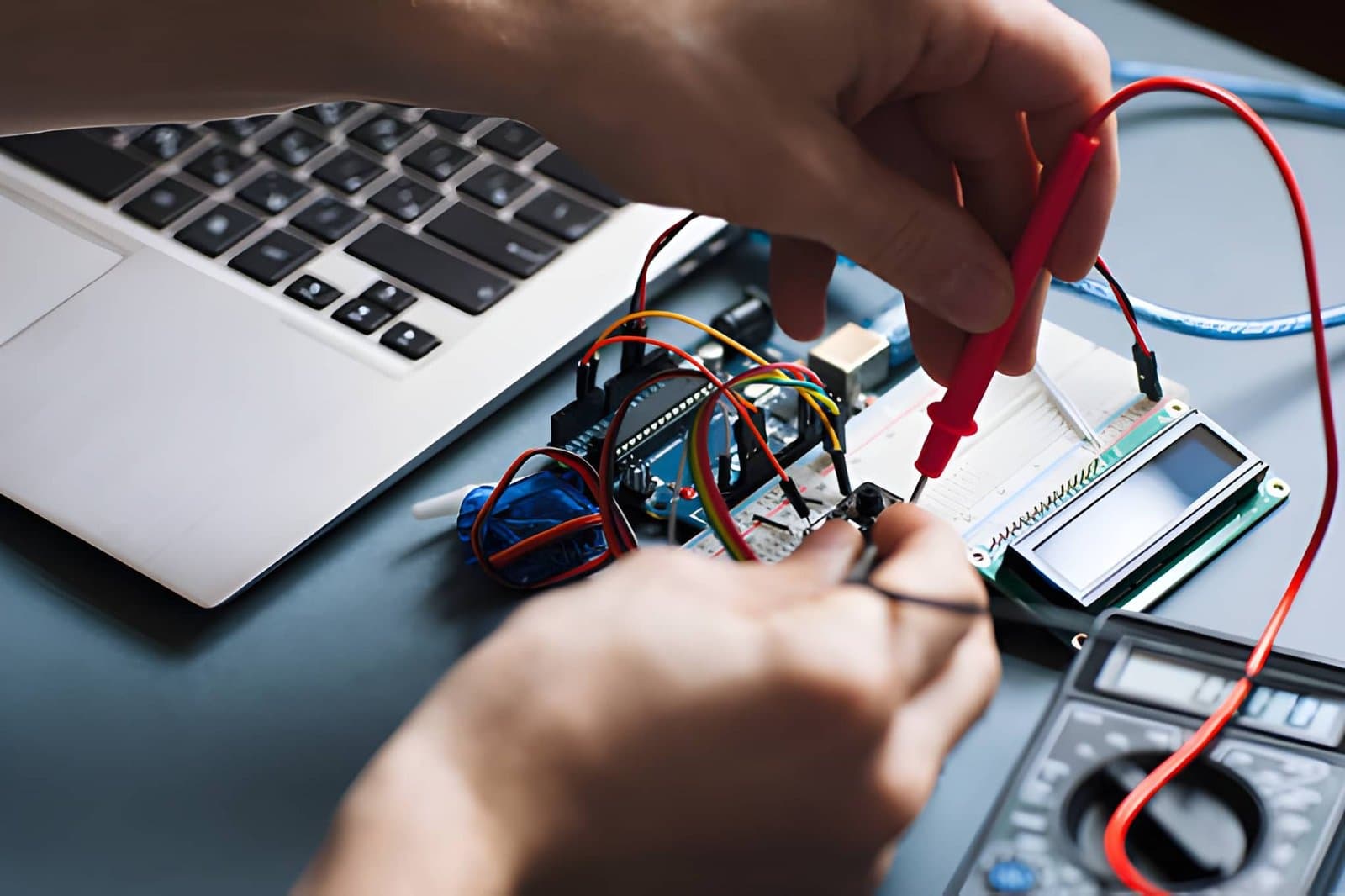
A robotics alternative: students build a simple LED circuit on a breadboard using an Arduino, a resistor, and an LED. They write a 5-line program to blink the light.
What changes:
- They choose resistor values, learning why a 220Ω resistor protects the LED
- They debug open circuits, understanding that a circuit must be complete
- They control the blink interval, making the math of milliseconds concrete
NCERT Class 6, Science, Chapter 12: Electricity and Circuits — LED blink projects directly demonstrate circuit completion, conductors vs. insulators, and the role of switches.
Class 7: Motion and Time
Chapter: Motion and Time (Science)
Class 7 introduces concepts of speed, distance, and time. The textbook approach uses word problems; the robotics approach uses an actual moving robot.
Students program a wheeled robot to travel a specific distance in a specific time, then measure whether it succeeded. They discover:
- Why speed = distance ÷ time isn't just a formula but a physical reality
- How gear ratios affect motor speed (a preview of Class 10 mechanics)
- Why measurement accuracy matters — small errors compound
Chapter: Heat (Science)
A temperature sensor connected to an Arduino gives students live data. Instead of looking at a thermometer, they write a program that triggers an LED when temperature crosses a threshold — a basic fire alarm.
Class 8: Force and Pressure, Sound
Chapter: Force and Pressure
Gripper robot projects are ideal here. Students build a mechanism with a servo motor that opens and closes based on sensor input. They experience:
- How force is applied through a lever (mechanical advantage)
- The difference between contact and non-contact forces
- Why pressure = force ÷ area matters when designing gripper pads
Chapter: Sound
A sound sensor module attached to Arduino lets students visualize what "frequency" and "amplitude" mean beyond textbook diagrams. Clap near the sensor and watch the serial monitor register the sound wave data.
Good to Know
Sound-sensing projects are particularly effective for students who are more auditory learners — the immediate hardware feedback creates a visceral understanding of wave concepts.
Class 9: Work, Energy, and Motion
Chapter: Work and Energy
A motor-driven car project makes the abstract concept of kinetic energy tangible. Students calculate the theoretical work done by the motor, then measure actual distance traveled. The discrepancy teaches them about energy loss (friction, heat) — concepts that appear in CBSE theory questions.
Chapter: Motion (Uniform and Non-Uniform)
Ultrasonic distance sensors allow students to measure how an object's distance changes over time. Plot those readings on graph paper and you have a distance-time graph — directly the content of Class 9 Chapter 8.
Class 10: Electricity, Magnetic Effects, and Light
This is where the robotics curriculum becomes most directly board-exam-relevant.
Chapter: Electricity
Ohm's Law, resistance, power, series and parallel circuits — all of these become hands-on when students design circuits for their robots. Instead of calculating the resistance of a combination circuit on paper, they build it and measure it with a multimeter.
Key experiments students can conduct:
- Verify Ohm's Law by measuring voltage and current at different resistance values
- Compare total resistance in series vs. parallel configurations
- Measure the power consumption of different LED setups
Chapter: Magnetic Effects of Current
DC motors are essentially practical demonstrations of the magnetic effect of current. When students wind their own electromagnet with copper wire and a battery, they experience Class 10 Chapter 13 rather than just reading it.
Learning Objectives
By the end of a well-structured robotics curriculum aligned with CBSE Classes 6–10, students should be able to:
- Explain Ohm's Law using actual circuit data they collected
- Describe the relationship between a motor and magnetic induction
- Apply the concept of work-energy to calculate theoretical vs. actual motor output
- Design a simple sensor-based automation system
The Assessment Alignment
CBSE board exams increasingly include "application-based questions" — questions that ask students to apply concepts to novel situations. Students who have physically built these systems answer application questions faster and more accurately because they have experiential mental models, not just memorized formulas.
The data from schools using curriculum-aligned robotics programs shows a consistent pattern: students score better on application and higher-order questions, even when theoretical knowledge is comparable to their peers.
Implementation for Schools
For schools beginning this integration:
- Start with one subject — electricity in Class 8 or 9 is the easiest entry point
- Map projects to chapters before purchasing hardware — avoid "cool robotics" that doesn't reinforce curriculum
- Train teachers — the science teacher's involvement is more important than the equipment
- Assess twice — once for the robotics project, once for the associated theory test
Robotics done right isn't a distraction from CBSE preparation. It's a deeper form of CBSE preparation.